
Chatham's Docking Station has planning consent but no road to it. A bid filed on 19 August would run a 3.1m lane from the Dockyard car park to the front door.
Docking Station, the University of Kent’s creative and digital hub at Chatham Historic Dockyard, is due to open early in 2027. It still has no road to its front door.
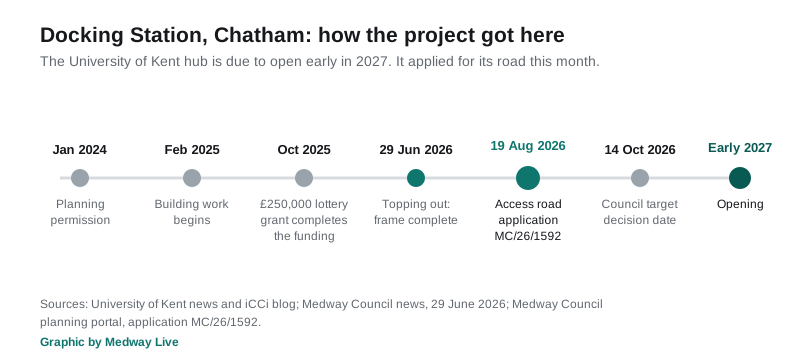
The university filed a planning application to fix that on Wednesday 19 August 2026. Reference MC/26/1592 covers the “formation of access road, footpath, disabled parking, lighting columns and associated works” on land west of the former Police Section House on East Road. Medway Council has set an internal target date of 14 October 2026 to decide it.
Why a finished building needs a new road application
The building work is already well advanced. The design and access statement records that the scheme was granted permission under reference MC/23/1834, the university announced the green light in January 2024, and work began in February 2025. Medway Council reported the topping out ceremony on 29 June 2026, which marks the structural frame reaching its highest point.
The access was always the loose end. The consented scheme assumed the building would be served from the north, via Brunel Way and a continuation of Pembroke Rise, as part of a wider masterplan for the neighbouring “Interface Land”.
That route has turned out not to work. The design and access statement filed with the new application, prepared by Clague Architects and dated 7 August 2026, says investigations found that continuing Pembroke Rise north towards Brunel Way “will encroach upon the root protection areas of a series of mature trees that line the northeastern boundary”.
So the road has been moved to the other side of the building, running in from the Historic Dockyard car park to the west. The statement makes the second reason plain: the new alignment lets the Docking Station project “be delivered independently of the timing and delivery of the ‘Interface Land’ masterplan”. In other words, the hub no longer has to wait for the housing scheme next door.
What is actually proposed
From the design and access statement:
- a 3.1m wide carriageway with a 1.5m footway alongside it, as a shared surface separated by a change of finish and a pin-edged kerb
- a turning head in front of the Section House, serving the loading bay on the north side of the building
- two accessible parking bays at the south-west end of the turning head
- five lighting columns with LED fittings, plus four bollard lights on the footpath link
- a footpath running north-east along the line of the disused Pembroke Rise to Brunel Way, linking the hub to the university’s main Medway campus across Dock Road
- landscaped earth bunds either side, built from the spoil dug out for the road and seeded with wild grasses and flowers
Vehicles are limited. The statement says the road is for deliveries to the loading bay serving the Docking Station and film studio, and for people using the two accessible bays. Everyone else parks in the Dockyard car park and walks. Bollards at each end of the turning head are there to stop unauthorised driving along Pembroke Rise.
The heritage constraints shaped every detail
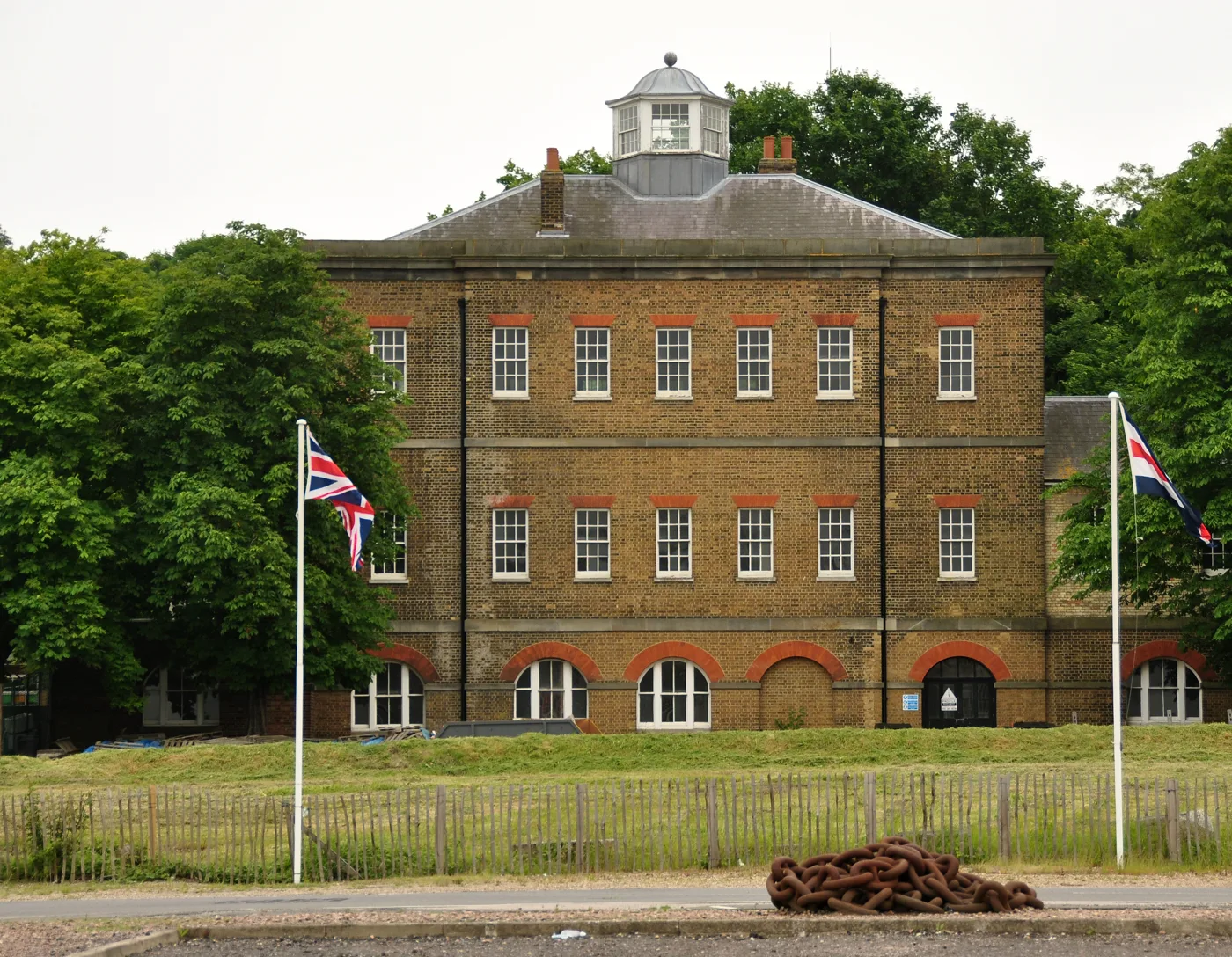
The site sits inside the Chatham Historic Docks Conservation Area, and the Section House itself is listed. Historic England records it at Grade II, list entry 1378642, describing a mid-19th century yellow stock brick building of three storeys with an octagonal ridge lantern under an ogee domed roof. The application’s own statement calls it Grade II*, which does not match the official list entry.
That lantern is why the road runs where it does. The centre line of the access is aligned with the centre of the Section House and its cupola, to create what the statement calls “a formal approach”.
The finishes follow the same logic. Plain tarmac or block paving was judged “inappropriate for the setting”, so the carriageway gets a tarmac wearing course with grey chippings rolled in and the footpath gets buff chippings, with conservation kerbs throughout and granite sets marking the threshold. The lighting is specified at a warm 3,000K colour temperature, chosen so it is “not harmful to bats within the area”, and to meet BS 5489-1:2020 and BS EN 13201-2:2015.
One neat consequence: the road is being built to adoptable standards but will not be adopted by the council. Because it stays private, it escapes the signage and road markings an adopted road would need, which the architects say would “add visual clutter to the setting”.
The scheme also needed consent beyond ordinary planning. The statement records Scheduled Monument Consent reference S00244973, issued by Historic England on behalf of the Secretary of State, alongside listed building consents MC/23/1833 and MC/25/1390, and a Section 73 amendment under MC/25/0604. Those earlier references can be looked up through the council’s planning application search.
What Docking Station will be
The consented use, as worded in MC/23/1834, is a part demolition and conversion of the former police section house for exhibition space, cafe, meeting space, post-production studios, office and co-working space, plus a new digital production studio building and rooftop solar panels.
The university’s Institute of Cultural and Creative Industries describes the finished building as a 360 creative production facility for screen, digital and immersive work. Medway Council’s account of the topping out lists virtual production and motion capture studios, specialist teaching labs, flexible exhibition space, co-working and office space, and business support for creative industries.
Funding came together in stages. The National Lottery Heritage Fund put in £250,000 in October 2025, which the university said secured the new studio building behind the Section House. Earlier support came from the government’s Levelling Up Fund, Arts Council England’s Cultural Development Fund and the Colyer Fergusson Charitable Trust.
At the topping out, Will Draffin, Director of Digital and Future Technologies for the institute, said: “This is an important moment in the development of Docking Station. We remain on track for opening early in 2027.”
Baxall Construction is the principal contractor. Savills is the planning consultant, and the agent on the access road application is Ben Tattersall of Savills.
What it means for you
Nothing changes on the ground yet, and the works are inside the Historic Dockyard estate rather than on a public road, so this is not a closure story. Three practical points:
- You can comment. The application is MC/26/1592 on Medway Council’s planning portal, where the full set of 29 documents is published. The council had not posted a consultation expiry date when we checked on 24 August, and its internal target date is 14 October 2026. Our Medway planning applications page explains how comments are made and weighed.
- Parking will not change for Dockyard visitors. The two new bays are for Docking Station users with impaired mobility. The main Historic Dockyard car park is where the application expects everyone else to park, and it is unaffected. See parking in Medway for the wider picture.
- A new walking route is part of the plan. The footpath along the old Pembroke Rise line would connect the Dockyard site to the university’s Medway campus on the other side of Dock Road.
The applicant says the approach has already been discussed with Medway Council, Historic England, Chatham Maritime Trust and Homes England, and that all four “have indicated that the approach is, in principle, acceptable”. That is the applicant’s account, made in its own supporting statement, and none of those bodies has published a formal response to this application yet.
Sources
- Medway Council planning portal, application MC/26/1592, received and validated 19 August 2026
- Clague Architects on behalf of the University of Kent, “Proposed Vehicular & Pedestrian Access, The Docking Station, Design & Access Statement”, 7 August 2026, filed with MC/26/1592
- Medway Council, Ancient rituals and cutting-edge technology collide at the Docking Station topping out ceremony, 29 June 2026
- University of Kent, Work begins on Docking Station, 6 February 2025, and Green light for groundbreaking new creative digital hub in Chatham, 22 January 2024
- Institute of Cultural and Creative Industries, Final funding found to secure a new state-of-the-art studio at Docking Station Medway, 10 October 2025
- Historic England, Police Section House, list entry 1378642
Have your say