
Medway's Planning Committee drops to 13 councillors on 31 October, call-in ends and objection counts stop counting. Two people will decide what is heard.
Medway is about to change who decides planning applications. The routes residents use to get one heard in public are the ones being closed.
The Planning Committee meets on Wednesday 23 September to comment on the changes. The decision itself goes to full Council on 15 October. The new rules take effect on 31 October 2026 whatever the council does, because they come from government regulations (officer report, item 8).
What actually changes
The council’s own report is blunt about the effect. It says: “Councillors will no longer have the ability to request an application to be referred to the Planning Committee. In addition, the number of representations made in respect of planning applications will not have a direct impact on whether an application should be referred to the Planning Committee.”
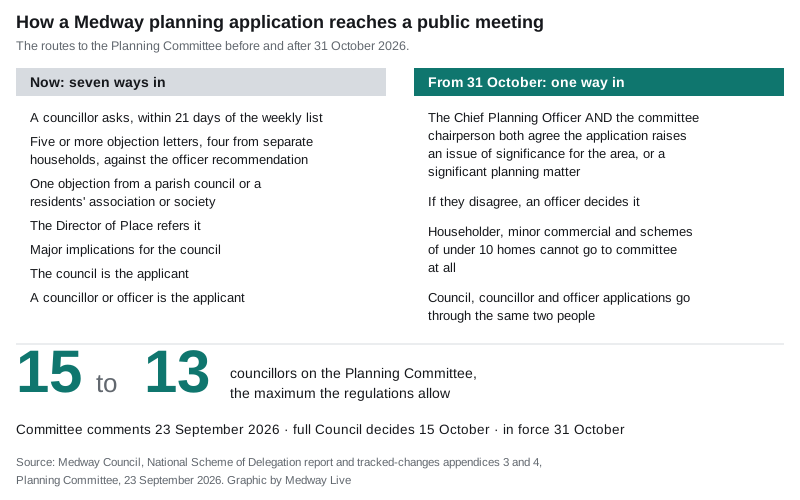
The tracked-changes appendix shows what is being struck out of Medway’s constitution (Appendix 4). Every one of these current triggers is deleted:
- a councillor asking, within 21 days of the weekly list, for an application to go to committee
- five or more letters of objection against the officer’s recommendation, provided at least four come from separate households
- one objection from a parish council or a residents’ association or society, where the parish asks for a committee decision
- the Director of Place referring a scheme that departs significantly from the development plan
- a proposal with “other major implications for the authority”
The committee also loses two jobs from its terms of reference: approving section 106 planning obligations offered by developers, and determining applications for approvals required by conditions or a development order (Appendix 3).
Two people instead
In place of those triggers there is a single route, called the Gateway Test.
Applications are sorted into two lists set by the regulations. Schedule 1 covers householder applications, minor commercial, minor residential of under 10 homes on less than half a hectare, discharge of conditions, reserved matters on all but the largest outline permissions, prior approvals, certificates of lawfulness and non-material amendments. Those must be decided by an officer. There is no discretion and no committee route at all.
Schedule 2 is everything else. It includes major housing, listed building applications, advertisements and tree preservation orders. Those are presumed delegated to officers as well. A Schedule 2 case can only be referred to the committee if one of these applies:
- it raises an economic, social or environmental issue of significance in the local area
- it raises a significant planning matter, judged against the development plan
- it is an “own-interest” application, meaning the council, a councillor or an officer is the applicant or has an interest
Who applies that test is the part worth knowing. The report proposes the Chief Planning Officer, Dave Harris, as nominated officer, and the Chairperson of the Planning Committee as nominated member. The two must agree. If they cannot, the report says the case is “referred to officers for determination”, so a disagreement means no public hearing.
The council will keep a record of every case the pair consider, and publish the outcomes on its website.
Fifteen councillors become thirteen
The regulations cap a planning committee at 13 members. Medway’s has 15, listed on Wednesday’s agenda as Councillors Stamp as chairperson, Jones as vice-chairperson, and Councillors Anang, Barrett, Bowen, Etheridge, Field, Gilbourne, Gulvin, Hamilton, Myton, Nestorov, Peake, Pearce and Vye (agenda, 23 September). The constitution’s entry changes from “up to 16” members to “up to 13”.
Two seats therefore go. The report does not say which two, or which political groups lose them.
Wednesday’s own agenda shows the stake
Three planning applications are listed for 23 September. Each officer report explains why it is at committee rather than on an officer’s desk, and all three give a reason that is being abolished.
- 65 Copenhagen Road, Gillingham, a retrospective change of use to a five-person house in multiple occupation. The report says it “would normally be determined under delegated powers but is being referred for Committee determination at the request of Cabinet members”, following the Article 4 direction on HMO conversions the council made on 22 January 2026 (report, item 5).
- 9 Clive Road, Rochester, a plan to turn a mid-terrace house into a children’s home, recommended for refusal. It drew 27 representations, objections from Councillors Finch and Howcroft-Scott and one from the City of Rochester Society. Councillor Murray wrote to call it in. The report says it is at committee “due to the balanced nature of the considerations and at the request of local councillors” (report, item 6).
- St John Fisher School, Maidstone Road, Chatham, 23 flats in the old school building and a new block behind, recommended for approval subject to a section 106 agreement worth £181,947. It is at committee “due to the number of representations contrary to the officer recommendation”, which came to seven objections from six people (report, item 7).
After 31 October, none of those three reasons exists. A councillor’s request, a society’s objection and a count of letters all stop working.
Why it is happening
The regulations are the Town and Country Planning (Discharge of Local Planning Authority Functions) (England) Regulations 2026, made on 15 July 2026 under the Planning and Infrastructure Act 2025 (legislation.gov.uk). They apply to every planning authority in England, so this is not a Medway decision in substance. Full Council can only decide how to comply.
Officers recommend compliance, and quote the government’s statutory guidance on what happens otherwise: decisions taken by a committee that should have gone to an officer “may be subject to judicial review by anyone aggrieved by the decision. This may lead to the quashing of the decision.”
The council’s own risk table lists a second risk alongside legal challenge: that “members, applicants, local residents and other stakeholders are unaware or unclear of the changes”. The action recorded against it is to communicate before the deadline.
What it means for you
- Objecting still matters, but it no longer summons a meeting. Officers must take account of representations either way. What changes is that the number of them no longer forces a public vote.
- If you want something heard in public, the argument has to be the trigger. From 31 October the case for referral has to be that the application raises an issue of significance for the area or a significant planning matter. A petition of neighbours is not, by itself, either of those.
- Check the category first. If it is a householder extension or a scheme of fewer than 10 homes, no amount of objection can take it to committee after 31 October. Our Medway planning applications guide explains how to find and comment on a live case.
- Watch the referral log. The council has committed to publishing the outcomes of the Gateway Test on its website and reporting them to the committee. That log is how anyone will be able to see what is being kept out of public view.
- The last chance to say anything about the changes is Wednesday. The committee meets at 6.30pm at the St George’s Centre, Pembroke, Chatham Maritime ME4 4UH, and there is a livestream. Full Council then decides on 15 October.
More on how the system works in Medway is on our planning news page.
Sources
- Medway Council, National Scheme of Delegation for Planning Applications, report to Planning Committee 23 September 2026
- Medway Council, Appendix 3, Planning Committee terms of reference (tracked changes)
- Medway Council, Appendix 4, Employee Scheme of Delegation extract (tracked changes)
- Medway Council, Planning Committee agenda, 23 September 2026, published 15 September 2026
- Officer reports for MC/26/1272, MC/26/1348 and MC/26/0561
- The Town and Country Planning (Discharge of Local Planning Authority Functions) (England) Regulations 2026, SI 2026/854
Have your say