
Every private let in seven Medway wards will need a council licence from 4 January 2027, at £840 a home or £1,600 an HMO. The wards, the rules and the fees.
Private landlords in seven Medway wards will need a council licence for every home they let from 4 January 2027. Medway Council’s Cabinet approved the schemes on 22 September. It had already agreed them once, on 4 August, but that decision lapsed.
The council admits why. The law requires a public notice in the affected areas within seven days of a designation. After the August meeting, “this requirement was not fully complied with”, so the decisions “were no longer effective”, according to an addendum report to Cabinet. The restart moved the launch from November 2026 to January 2027.
The quick answer
- Starts: 4 January 2027, for five years.
- Selective licensing covers almost every privately rented home in seven wards: Chatham Central and Brompton, Fort Pitt, Gillingham North, Gillingham South, Luton, Strood North and Frindsbury, and Watling.
- Additional licensing covers smaller shared houses (HMOs) in six of those wards. Strood North and Frindsbury is the one left out.
- Fees: £840 per home for a selective licence and £1,600 per HMO for an additional licence, paid once for five years.
Which homes need a licence
There are two schemes, and a landlord’s property falls into one or the other.
Selective licensing applies to homes let to a single household, such as a family, or to two unrelated sharers. Every such home in the seven wards will need a licence to be let legally, according to the consultation report. A landlord with several properties needs a licence for each one.
Additional licensing applies to houses in multiple occupation that fall below the national mandatory threshold. In practice that means homes where three or more people from two or more households share a kitchen or bathroom. Larger HMOs already need a mandatory licence and stay under that system (Medway Council: HMOs).
The scheme summary lists the main exemptions:
- homes let by the council or a housing association
- properties already licensed as a mandatory HMO
- properties under a temporary exemption or a management order
- tenancies exempt under the 2006 national exemptions order
The council’s own map of the additional licensing area shows a single block running from Fort Pitt through central Chatham and Luton to Gillingham North and Watling (Appendix F). Twydall, Rainham, Rochester, Walderslade, Hoo and the rural wards are outside both schemes.
What it costs
The fee is paid in two parts. Part A covers processing the application. Part B is charged once the application succeeds and before the licence is issued. The total covers the full five years and is not charged annually (fee structure).
| Licence | Part A | Part B | Total |
|---|---|---|---|
| Selective (per home) | £436 | £404 | £840 |
| Additional HMO (per property) | £830 | £770 | £1,600 |
Three discounts are available:
| Discount | Selective | Additional HMO |
|---|---|---|
| Accredited landlord (10%) | £756 | £1,440 |
| Multiple properties in one freehold (12.5%) | £735 | £1,400 |
| Charity (25%) | £630 | £1,200 |
The consultation report says the charity discount cannot be combined with the others. The council says the fees are set so the schemes cover their own costs, and it did not change them after the consultation (Cabinet report).
What landlords must do
Licence holders must pass a “fit and proper person” test, and so must anyone involved in managing the property. Conditions cover:
- how the property is managed
- fire safety
- dealing with anti-social behaviour by tenants
- providing references for tenants who move on
The council can refuse a licence. Landlords can appeal a refusal, a variation or a revocation, and the refusal letter explains how.
Tenants backed it, landlords did not
An independent consultancy, Transform, ran the consultation from 23 March to 4 June 2026. It received 209 survey responses. The online survey closed early because of a technical fault, so the council reopened it twice (consultation report).
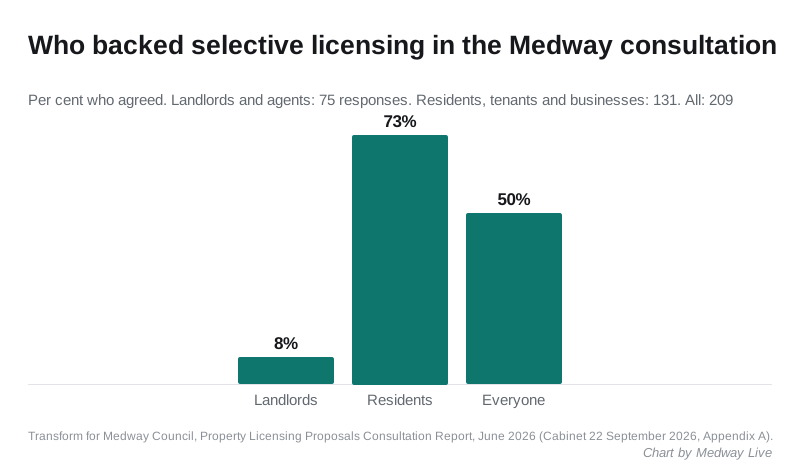
The split was stark:
- 73% of the 131 residents, tenants and businesses agreed with selective licensing.
- 8% of the 75 landlords, letting agents and managing agents agreed, and 81% disagreed.
- 92% of landlords and agents said the selective fee was too high.
- 44% of residents said it was too low.
Support for additional HMO licensing was higher: 56% agreed and 28% disagreed.
Landlord groups argued the council should use the powers it already has. One response cited a Freedom of Information reply showing seven civil penalties across 2023/24 and 2024/25. The council answered that it had issued 26 fixed penalty notices so far in 2025/26 and 33 since 2023/24 (council response to comments).
The council’s own risk table accepts that “costs may be passed to tenants”, or that some landlords may leave the market. It also lists the risk that problems shift to wards outside the schemes.
What it means for you
- If you let a home in one of the seven wards, you will need to apply for a licence before 4 January 2027. Check your ward on the council’s map and watch for the formal notice, which must be published within seven days of the decision.
- If you rent privately in those wards, your landlord will have to meet the licence conditions. That gives you a route to the council if they do not.
- If you own a small shared house in any of the six HMO wards, it now needs a licence even if it was below the mandatory threshold.
The decision was treated as urgent. Call-in was waived with the agreement of the chair of the council’s regeneration scrutiny committee, so it takes effect without a further review. Planning permission for HMOs is a separate question: our report on three Gillingham HMO refusals shows how the planning committee has been treating them, and new applications appear on our planning applications page.
Have your say