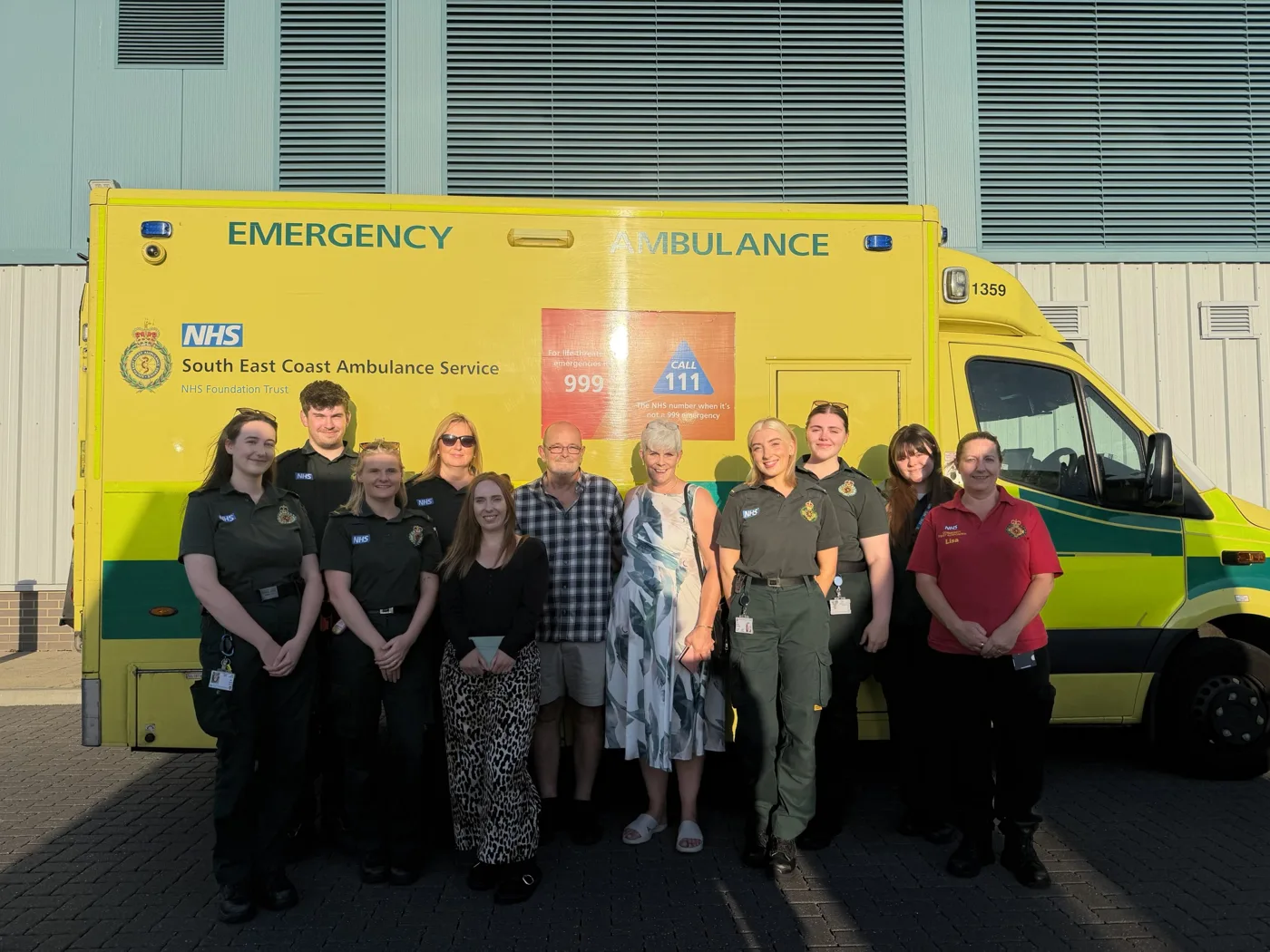

Rob, 59, went into cardiac arrest seven times outside his Lordswood home in May. He has now thanked the SECAmb crews who spent nearly two hours saving him.
A Lordswood man whose heart stopped seven times while ambulance crews worked on him has met the people who saved his life.
Rob, 59, was washing his car at the family home on 18 May when his arm went numb and he felt pains in his chest. His wife, Sue, called 999 straight away. Ten weeks later he went to Medway Make Ready Centre to thank the call handlers, paramedics and volunteer who kept him alive, South East Coast Ambulance Service (SECAmb) said on Thursday.
“Without all of their help the outcome could have been a different story I’m sure,” Rob said. “I will be forever in their debt.”
The trust uses only Rob and Sue’s first names.
Nearly two hours at the scene
Resource dispatchers Amie and Emily, at the trust’s Gillingham Emergency Operations Centre, sent Lisa, a Community First Responder, to the house. Paramedic Georgia and Associate Ambulance Practitioner Jenni arrived shortly afterwards. While the three of them were assessing Rob, he went into cardiac arrest in front of them.
Paramedic Cameron and Associate Ambulance Practitioner Grace joined the resuscitation, along with Critical Care Paramedic Chris, who gave Rob an anaesthetic bundle to support his recovery and help protect his brain after the arrest.
The team got Rob’s heart going again, but it stopped a further six times. The crews kept treating him where he was, working to get a heartbeat that would hold. It was nearly two hours after Sue’s 999 call before his heart settled into a regular rhythm. He was taken to William Harvey Hospital, where surgeons removed a blockage from an artery.
Cameron said:
“Seeing Robert walk into the room was a great feeling. Considering the last time I saw him he was post cardiac arrest and still suffering from a heart attack, Robert’s outcome demonstrates how vital early recognition, early CPR, early defibrillation and rapid transfer to advanced care are to a patient’s survival in cardiac arrest. This incident is a prime example that shows how good interagency working and strong teamwork provides the absolute best outcome for our patients.”
A second call within a month
Recovery was not straightforward. Within a month of leaving hospital Rob had chest pains again and the ambulance service was called back. Associate Ambulance Practitioner Holly and Paramedic Lucy took him to Medway Maritime Hospital for further care.
At the reunion he thanked Lisa, Georgia, Jenni, Cameron, Grace, Holly, Lucy, Amie and Emily in person. He has little memory of what happened that day, so the meeting was his chance to hear what the crews did, and theirs to find out how he got on after he left their care.
The trust’s best survival month on record
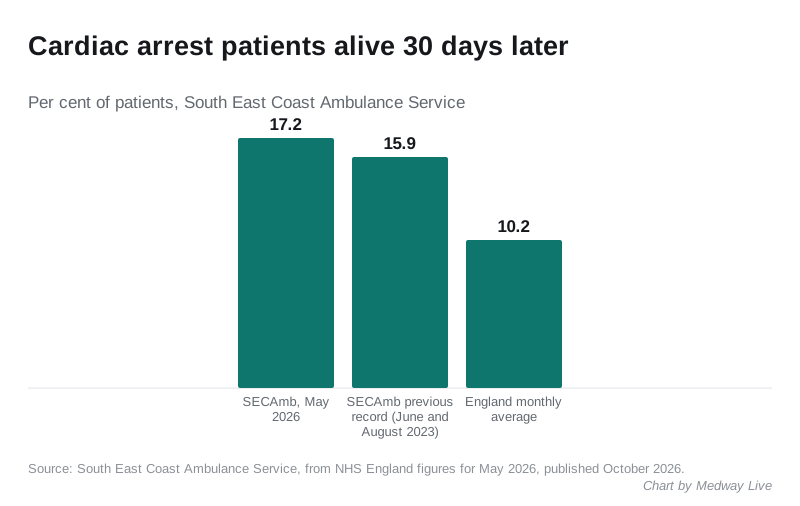
The reunion comes as SECAmb reports its best month yet for cardiac arrest survival. NHS England figures for May 2026, the month Rob collapsed, show 17.2 per cent of the trust’s cardiac arrest patients were alive 30 days later. Its previous best was 15.9 per cent, in June and August 2023. The monthly average across England was 10.2 per cent, and the trust says May’s figure put it top nationally.
The trust has set itself a target of raising cardiac arrest survival by a further 5 per cent by 2029, as part of its five-year strategy.
What anyone can do
SECAmb says every link in the chain counts, from noticing that something is wrong and ringing 999, through the community responder and the crews, to the hospital. For every minute someone stays in cardiac arrest without CPR and a defibrillator, their chance of survival falls by about 10 per cent, the trust says.
You can learn CPR through the trust.s CPR page.
Have your say